Kinematics is a branch of classical mechanics that describes the motion of points, bodies (objects), and systems of bodies (groups of objects) without considering the forces that caused the motion. Kinematics, as a field of study, is often referred to as the “geometry of motion” and is occasionally seen as a branch of mathematics. A kinematics problem begins by describing the geometry of the system and declaring the initial conditions of any known values of position, velocity and/or acceleration of points within the system. Then, using arguments from geometry, the position, velocity and acceleration of any unknown parts of the system can be determined. Kinematics analyzes the positions and motions of objects as a function of time, without regard to the causes of motion. It involves the relationships between the quantities velocity (v), acceleration (a), speed, and free fall.

Speed is a scalar quantity that refers to “how fast an object is moving.” Speed can be thought of as the rate at which an object covers distance. A fast-moving object has a high speed and covers a relatively large distance in a short amount of time. Contrast this to a slow-moving object that has a low speed; it covers a relatively small amount of distance in the same amount of time. An object with no movement at all has a zero speed.
The average speed during the course of a motion is often computed using the following formula:

Example:
John drove for 3 hours at a rate of 50 miles per hour and for 2 hours at 60 miles per hour. What was his average speed for the whole journey?
Solution:
Step 1: The formula for distance is
Distance = Rate × Time
Total distance = 50 × 3 + 60 × 2 = 270
Step 2: Total time = 3 + 2 = 5
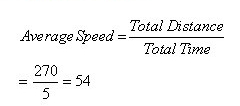
Answer: The average speed is 54 miles per hour.
Be careful! You will get the wrong answer if you add the two speeds and divide the answer by two.
Units of speed include:
- metres per second (symbol m s−1 or m/s), the SI derived unit;
- kilometres per hour (symbol km/h);
- miles per hour (symbol mi/h or mph);
- feet per second (symbol fps or ft/s)
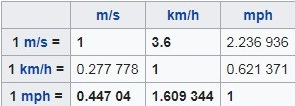
Conversions between common units of speed

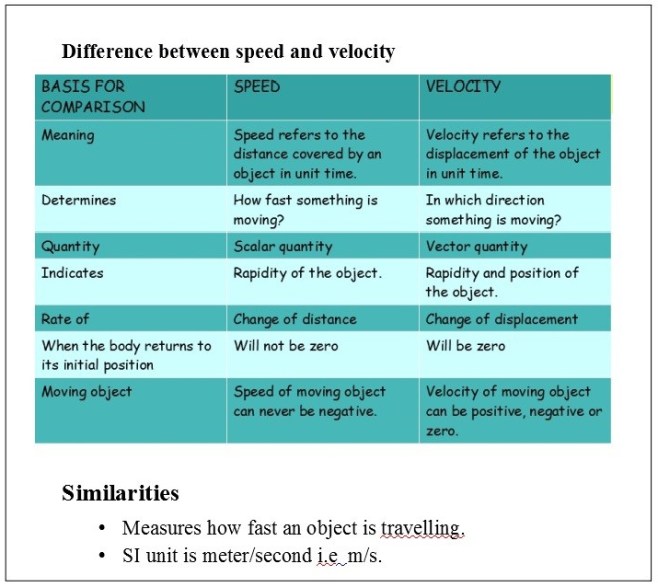
Velocity is a vector quantity that refers to “the rate at which an object changes its position.” Imagine a person moving rapidly – one step forward and one step back – always returning to the original starting position. While this might result in a frenzy of activity, it would result in a zero velocity. Because the person always returns to the original position, the motion would never result in a change in position. Since velocity is defined as the rate at which the position changes, this motion results in zero velocity. If a person in motion wishes to maximize their velocity, then that person must make every effort to maximize the amount that they are displaced from their original position. Every step must go into moving that person further from where he or she started. For certain, the person should never change directions and begin to return to the starting position.
In contrast, the average velocity is often computed using this formula

a)

|
average speed =
|
distance
time
|
=
|
7 km + 2 km
2 hours + 1 hour
|
=
|
9 km
3 hours
|
= 3 km/h |
b)
|
average velocity =
|
displacement
time
|
=
|
7 km + 2 km
2 hours + 1 hour
|
=
|
9 km
3 hours
|
= 3 km/h |
Common symbols v
Other units mph, ft/s
In SI base units m/s

Acceleration, rate at which velocity changes with time, in terms of both speed and direction. A point or an object moving in a straight line is accelerated if it speeds up or slows down. Motion on a circle is accelerated even if the speed is constant, because the direction is continually changing. For all other kinds of motion, both effects contribute to the acceleration.Because acceleration has both a magnitude and a direction, it is a vector quantity.
The average acceleration (a) of any object over a given interval of time (t) can be calculated using the equation

a = acceleration (m/s2)
Vf = the final velocity (m/s)
vi = the initial velocity (m/s)
t = the time in which the change occurs (s)
Δv = short form for “the change in” velocity (m/s)
The units for acceleration are meters per second squared (m/s2).
Example:
A soccer ball slows down from 30.6 m/s, west to 11 m/s, west during a 2.75 second period.
What is its average velocity? What is its average acceleration?


A free falling object is an object that is falling under the sole influence of gravity. Any object that is being acted upon only by the force of gravity is said to be in a state of free fall. There are two important motion characteristics that are true of free-falling objects:
- Free-falling objects do not encounter air resistance.
- All free-falling objects (on Earth) accelerate downwards at a rate of 9.8 m/s/s (often approximated as 10 m/s/s for back-of-the-envelope calculations)
Like any moving object, the motion of an object in free fall can be described by four kinematic equations. The kinematic equations that describe any object’s motion are:

The symbols in the above equation have a specific meaning: the symbol d stands for the displacement; the symbol t stands for the time; the symbol a stands for the acceleration of the object; the symbol vi stands for the initial velocity value; and the symbol vf stands for the final velocity.
Example:
Rex Things throws his mother’s crystal vase vertically upwards with an initial velocity of 26.2 m/s. Determine the height to which the vase will rise above its initial height.
| Diagram: | Given: | Find: |
|---|---|---|
 |
vi = 26.2 m/s vf = 0 m/s a = -9.8 m/s2 |
d = ?? |
vf2 = vi2 + 2 • a • d
(0 m/s)2 = (26.2 m/s)2 + 2 •(-9.8m/s2) •d
0 m2/s2 = 686.44 m2/s2 + (-19.6 m/s2) •d
(-19.6 m/s2) • d = 0 m2/s2 -686.44 m2/s2
(-19.6 m/s2) • d = -686.44 m2/s2
d = (-686.44 m2/s2)/ (-19.6 m/s2)
d = 35.0 m

 Physics Blog